Pregnancy Endings exhibition
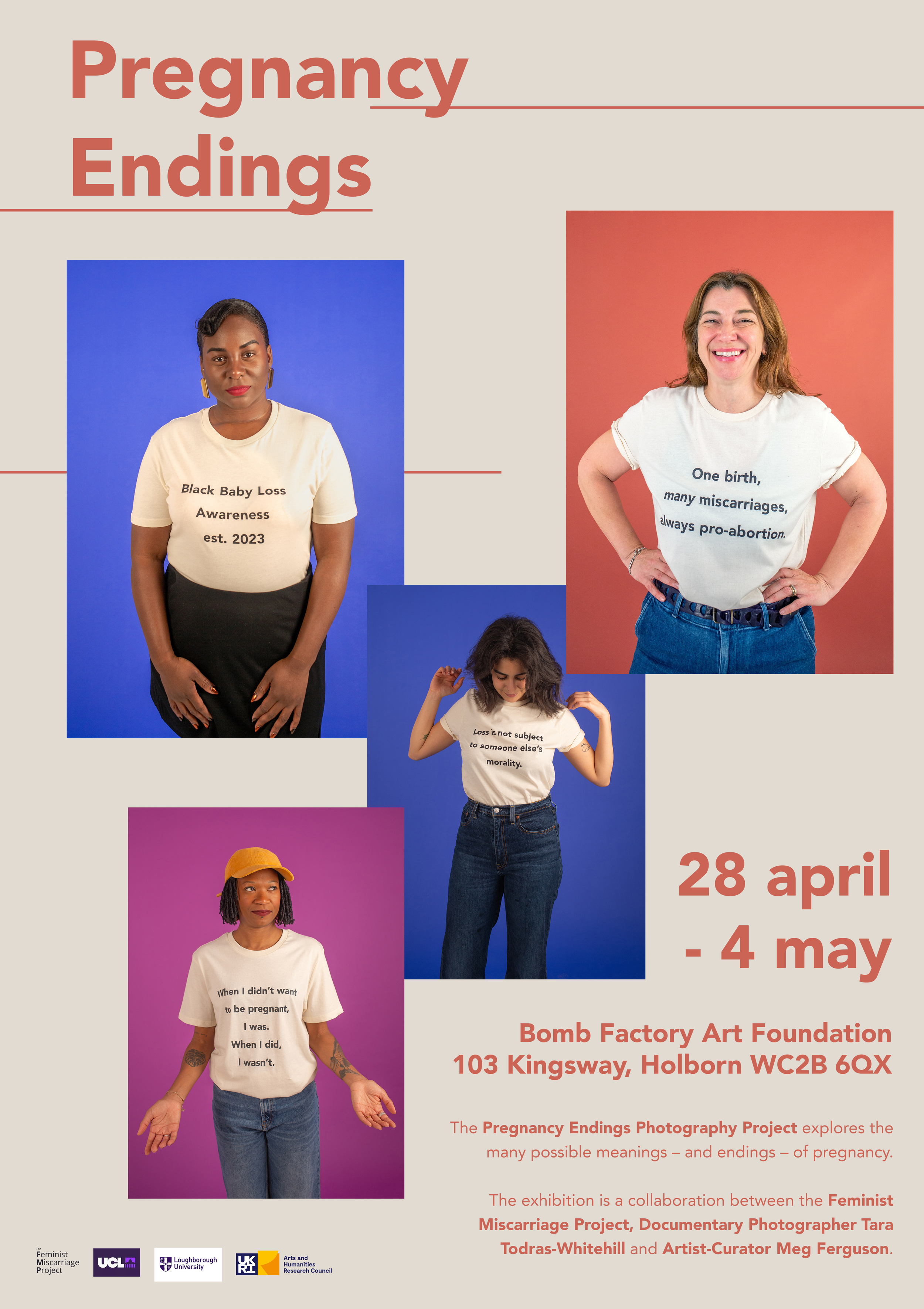
Last week, our exhibition Pregnancy Endings was on show at the Bomb Factory Art Foundation gallery in Central London (April 28 – May 4). The exhibition is a collaboration between the FMP, photographer Tara Todras-Whitehill, and artist-curator Meg Ferguson, bringing together portraits of people wearing t-shirts with self-devised statements that reflect the full spectrum of pregnancy endings, including birth, abortion, miscarriage, stillbirth, and more.
The idea for the exhibition came from a passage in my book, Pregnancy Without Birth, which insists on the inescapability of ambiguity in pregnancy. By this I mean not only that pregnancy is open to multiple meanings and lived in different ways, but also that it’s a fundamentally uncertain bodily situation. Pregnancy is lived through shifting meanings, partial knowledge, and indeterminate outcomes, which is why experiences like miscarriage can feel so disorienting. It’s not only the ending itself that can throw us off course, but the way it exposes something already true of pregnancy. The not-yets,not-quites, almosts, kind-ofs and alsos that emerge in miscarriage are also there throughout pregnancy, however and whenever it begins and ends, and however much we like to tell simple stories about “having a baby”.
In this part of the book, though, I acknowledged that simplicity is often more effective than ambiguity when it comes to political campaigning. “‘Ontological ambiguity now!’ is unlikely to take off as a t-shirt slogan,” I wrote. But at the same time, I wanted to resist the idea that ambiguity belongs only to academic theory. As Brittany Leach argues, accounts of pregnancy that make space for ambivalence, uncertainty, variation and contradiction, can in fact strengthen political claims for reproductive freedom precisely because they resonate more closely with how pregnancy is actually lived.
So after the book was published, I found myself returning to that line. Was “Ontological ambiguity now!” really such a bad t-shirt slogan? What kinds of slogans might begin to express the complexity and variability of pregnancy without collapsing it into a single, simplified narrative?
I thought about powerful stigma-busting campaigns like I Had an Abortion — a photographic series by Tara Todras-Whitehill, in which reproductive rights and justice activists, including Loretta Ross and Gloria Steinem, were photographed wearing T-shirts declaring “I had an abortion” — and the I Had a Miscarriage campaign on Instagram led by writer and psychologist Jessica Zucker. The simplicity of these slogans is precisely the point: they make clear statements that demand recognition and invite questions about the stories behind them.
But for many people, such simplicity isn’t easy. Experiences don’t always fit neatly into categories like “abortion” or “miscarriage.” What about someone who has had an abortion but understands it instead through the lens of “pregnancy loss” because it was a wanted pregnancy and a decision they felt they had no choice about? Or someone who feels they have lost a pregnancy but isn’t sure if they were ever pregnant? Or someone who rejects the term “miscarriage” altogether? And what about those who have experienced both miscarriage and abortion – which campaign do they belong to?
These are not unusual cases; they are part of the ordinary complexity of reproductive life. And I began to wonder: Could we create a project that reflects the full spectrum of pregnancy endings, all at the same time, and that amplifies ambiguity rather than covering it over? So I contacted Tara, the creator of I Had an Abortion, to ask what she thought about making a new series along these lines, and was delighted when I received an enthusiastic response.
The next step was to recruit participants. Susie Kilshaw (FMP Co-Lead) and I knew we needed a wide range of experiences. We initially hoped for around 15–16 people, but the project quickly grew. I reached out to people we knew, people who had spoken publicly, and others I found through their online profiles. We wanted diversity not only in terms of personal experiences, but also perspectives: people speaking about their own pregnancies, as well as clinicians, doulas, activists, friends, and family members who support others through them.
One experience that proved particularly difficult to find was miscarriage experienced with relief. This response is largely absent from public narratives, in part because expressions of grief have become so dominant lately. But Susie, with her anthropologist’s commitment to staying true to lived experience, found people willing to share these stories.
We left the t-shirt statements entirely open — no word limits, no templates. And in the end, nearly 50 people took part. We were amazed by how many people came forward, with participants spreading the word among their friends and networks.
The photoshoots took place over four days in November 2025 and January 2026. Organising it all was a steep learning curve as I’d not organised anything like this before. Academic conferences and workshops, yes. Hiring lighting equipment and choosing colour backdrops, no. Thankfully, my brilliant friend, artist and curator Meg Ferguson, led on the aesthetic side — designing the t-shirts and selecting a beautiful colour palette, as well as going on to curate the exhibition in the gallery.
The shoot days themselves in East London were unforgettable. Tara brought such a calm presence, quietly inviting participants to share as much or as little as they wanted to. People chose how they wanted to be photographed based on how they felt that day, and there was a strong sense of camaraderie. Some looked through the t-shirts on the rail and read the slogans of others; some recognised each other and had a catch up; people shared tips for being less shiny (blotting paper!) and helped each other pin back t-shirts that needed adjusting, waiting patiently and respectfully when schedules overran.
One especially memorable moment was photographing a group of NHS staff at Homerton hospital, organised by Jayne Kavanagh from the FMP advisory board. Many of her colleagues couldn’t come to the studio due to shift work, so we brought the shoot to them. Luckily Tara, a documentary photographer who travels the globe, was up for the challenge and we had Susie’s research assistant Caroline to help as well. We had the full lighting kit delivered to the hospital carpark and met Jayne in the Gynaecology department, where she marshalled together ten of her colleagues who gamely put the t-shirts on over their uniforms, helped us clear a space and put up a backdrop in an examination room, and posed for the picture around a bed I may well have lain on during my own pregnancies.
I’m now writing this the day after the exhibition has closed. It’s been deeply moving to see such a range of people and statements displayed on the gallery walls, side by side, all week. Statements by two teenagers about the need for honest education have been displayed across from a statement reflecting on a miscarriage that took place forty years ago. A statement about a traumatic experience of stillbirth has sat alongside one describing a miscarriage as a relief. At times, these kinds of positionings may feel uncomfortable, and we would never try to dictate how anyone should respond, or judge those for whom such proximity is too much to cope with. But what the exhibition has shown is the possibility of connection across difference — a form of solidarity not based on uniformity, but on a shared commitment to reproductive justice, health equality and mutual support. And creating the space itself has also enabled that solidarity to be built. At the opening evening, participants met and shared stories of the photoshoots and being part of the project, photographing each other in front of the portraits. Friends, family members, partners, colleagues and children came along to support them.
The t-shirt statements themselves aren’t always easy to read at first glance, but this has turned about to be a real strength. The viewer has to take time to look closely and take them in, and think through their implications. Over the week, I’ve watched people pause at the gallery windows and peer in, coming in and taking time to look, and to read carefully through the exhibition booklet where participants have so generously written longer pieces about their experiences. And we certainly had a range of people coming in: a jogger who stopped by during the opening evening in full running outfit and later got in touch; a couple visiting London from China who wrote a message in the visitors’ book in Mandarin; a family whose young daughter ran around the gallery choosing her favourite portraits; an elderly man who spoke about his late wife’s fertility struggles and gave me a handmade bracelet.
I feel incredibly privileged to have had these experiences, and deeply grateful to everyone who contributed to making this exhibition possible. This is a beginning as well as an ending, and I’m excited to see where it goes next.
As one person commented in the visitors’ book: "I walked past this exhibition exactly when I needed to. Thank you".