Blood of the Lamb
Blood of the Lamb: a play by Arlene Hutton
Brought to the ReproSalon by Occasional Drawl
Performed by Meredith Garretson, actor (Nessa) and Christa Scott-Reed, actor and Chief Creative Officer, Occasional Drawl (Val)
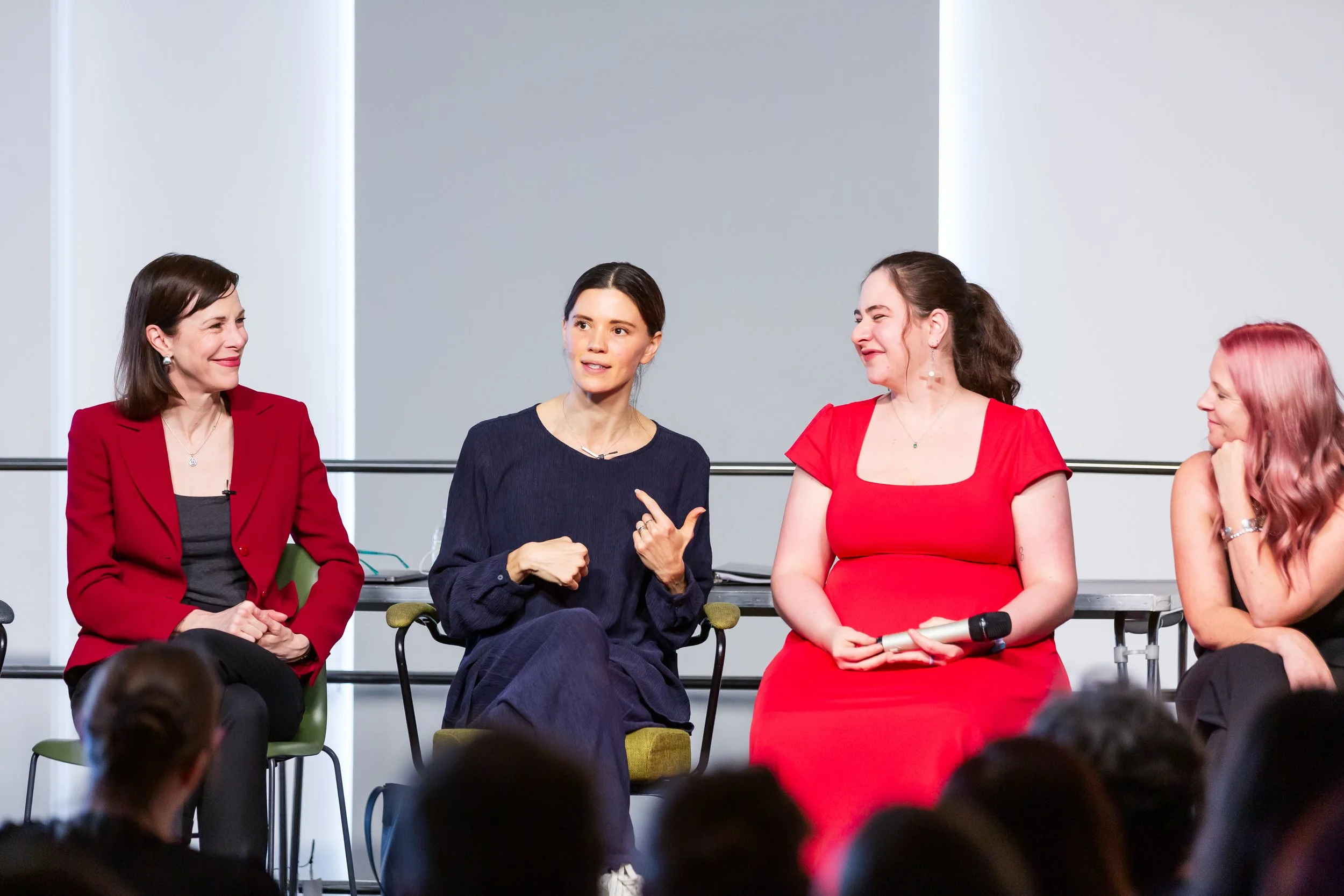
Photo credited to Henri T @documentedbyhenrit
On Friday May 29th, I had the pleasure of attending the annual ReproSalon warmly hosted by Lucy van de Wiel and the Reproduction Research Group, King's College London. Those of us in attendance were treated to a performance of the New York Off-Broadway theatre production Blood of the Lamb. A provocative play set in a post-Roe America, Blood of the Lamb has been described by The Guardian as “the best of political theatre” and praised as “a powerful piece of activism” that vividly exposes infrastructural reproductive injustices with “admirable subtlety, control and power.” As the play deals with pregnancy endings, I was asked to be part of a panel responding to the play. Following the powerful performance I joined on stage the actors, Brian Letchworth, Occasional Drawl’s Founder and Producer, and Mira Michels, a theatre lover and reproductive health researcher at King's College London, who organised the event after seeing the play's premiere in New York City in 2024.
The play touches on many issues that are central to both my research and the aims of the FMP. I therefore want to reflect on three themes that resonate most strongly: foetal personhood, approaches to pregnancy tissue following miscarriage, and the often-hazy boundaries between miscarriage and abortion.
I was immediately struck by how plausible the play’s fictional scenario felt. Rather than presenting a distant dystopia, Blood of the Lamb imagines a future that appears to be a logical extension of post-Roe abortion restrictions in Texas, the growing influence of foetal personhood legislation, and state power over reproductive healthcare. This dynamic became especially visible following the 2024 Alabama IVF ruling, which treated frozen embryos as legal children and temporarily disrupted IVF services across the state. As Risa Cromer has shown, personhood laws are not merely abstract debates about when life begins; they form part of a broader political and religious project that uses embryos and foetuses to reshape ideas of citizenship, family, race, and reproductive rights. Through evangelical Christian activism around IVF, embryo adoption, and anti-abortion legislation, embryo and foetal personhood is actively produced as a social and political reality.
Several moments in the play hinted at the connection between personhood movements and white evangelical visions of America, particularly in exchanges where Val questions Nessa about her partner. As Cromer argues, personhood laws are closely tied to conservative Christian nation-building projects that promote heterosexual family-making and reinforce traditional gender roles. These interactions also underscore the extent to which Nessa’s pregnancy was wanted. As a lesbian couple, she and her wife invested significant emotional, financial, and practical resources in becoming pregnant, echoing themes explored by Christa Craven in her work on reproductive loss among LGBTQ+ families.
Nessa’s detention rests on the premise that her foetus is a separate legal person endowed with independent rights. Under these laws, the foetus is considered a baby and, following its death, a corpse. The legal issue therefore becomes about the treatment and transportation of human remains, which impact miscarriage management. As Val explains, the charge concerns “disturbing or damaging a human corpse … or transporting a corpse,” both felony offences.
This legal framework has significant implications for miscarriage care. Uterine aspiration—the procedure commonly used to manage missed or incomplete miscarriage—necessarily involves the removal and fragmentation of foetal tissue. In the UK, this procedure is generally referred to as Manual Vacuum Aspiration (MVA) when performed under local anaesthetic, or surgical management of miscarriage (SMM) when performed under general anaesthetic. Importantly, the procedure is medically identical to a surgically managed abortion, highlighting the profound entanglement of miscarriage and abortion in clinical practice. At one stage Val goes into detail explaining to Nessa what happens during an abortion in graphic terms.
I was struck by the play’s omission of medical management, which uses medications such as mifepristone and misoprostol to induce uterine contractions and expel pregnancy tissue. This absence is understandable given the narrative focus on the legal consequences of “damaging” a foetal corpse; medical management often results in the expulsion of tissue that remains relatively intact. Nevertheless, the omission may also reflect broader cultural differences in miscarriage care. In the UK, surgical intervention would be uncommon for a second-trimester miscarriage, making the play’s scenario feel particularly rooted in an American medical and legal context, perhaps.
The play’s focus on the foetal body resonated strongly with my own research on the handling and disposal of pregnancy and foetal tissue following early miscarriage. Like Blood of the Lamb, my work examines how institutions and individuals attribute meaning and value to the biological material of pregnancy endings. I have found that disposal practices in clinical contexts in England are increasingly shaped by assumptions of bereavement and construct forms of foetal personhood that do not necessarily align with how women themselves understand their pregnancies, their pregnancy endings, or the tissue involved.
In the play, legal ideology overrides concern for Nessa’s health, safety, and bodily autonomy. The dignity of the dead foetus is prioritised over the wellbeing of the living woman. Similar dynamics emerged in my own research. Practices intended to demonstrate respect and sensitivity toward foetal remains appeared to take precedence over the needs and wishes of women themselves. Moreover, interventions designed to be compassionate were often experienced as distressing, inappropriate, or alienating by those who encountered them.
The play’s preoccupation with the dead foetal body is particularly timely. In recent years, several women in the United States have been arrested for “abuse of a corpse” after disposing of miscarried foetuses outside formal medical settings. Historian Lara Freidenfelds argues that such prosecutions, accelerating in post Dobbs America, are a means for prosecutors to criminalise women who miscarry at home on the grounds, they have not handled foetal remains as though they were a corpse and to punish them for not interpreting miscarriage as the loss of a baby. Risa Cromer and Sophie Bjork-James make a related argument in their work on foetal burial and “foetal funeral” legislation, describing the legal construction of dead foetuses as grievable human life in US law as “an anthropological curiosity. ” These laws seek to normalise particular forms of mourning and to legislate emotional responses based on assumptions about foetal personhood.
Foetal disposal laws vary considerably across the United States. Several states require healthcare providers to treat tissue from abortions and miscarriages in ways similar to deceased human remains, mandating burial or cremation and prohibiting disposal through standard domestic or medical waste systems. Texas, the setting of Blood of the Lamb, has some of the strictest requirements, alongside states such as Indiana, Ohio, Louisiana, Arkansas, and South Carolina.
A final striking resonance between the play’s message, mine and Victoria Browne’s work, and a key aim of the FMP, is the entanglements between miscarriage and other pregnancy endings. Recently, Vic and I have explored the lived experiences of pregnancy endings to demonstrate the complexity of distinguishing between miscarriage and abortion. Our work highlights the porous boundaries between these categories and argues for a maximally inclusive, full-spectrum approach to pregnancy endings. Blood of the Lamb, like the documentary Zurawski v. Texas screened by the FMP last year, offers a powerful illustration of these entanglements. Both show how laws designed to restrict abortion inevitably affect those experiencing miscarriage. As Vic and I argue, meaningful social support for miscarriage cannot be achieved while abortion remains stigmatised, restricted, or excluded from reproductive justice frameworks.
Recent research published in JAMA reinforces this point. The study found that state-level abortion bans were associated with significant changes in miscarriage care, including a shift away from medication management and toward expectant management, as well as continued reliance on less effective misoprostol-only regimens in states with abortion restrictions. The authors conclude that abortion bans do not remain confined to abortion care alone; rather, they reshape the entire continuum of pregnancy care. In this respect, Blood of the Lamb serves not only as political theatre but also as a stark warning about the far-reaching consequences of reproductive regulation.
Whilst there hadn’t been such input at the time of writing, ongoing discussions with clinicians and academics have helped the team to shape the performance, something which is ongoing given changes in the landscape of reproductive politics in the US. In this way, Blood of the Lamb is an example of how collaborations between creatives, academics, clinicians and activists can produce powerful and compelling work. Indeed, theatre is a particularly powerful medium for exploring reproductive politics because it transforms abstract legal debates into lived, embodied experiences. By inviting audiences to witness Nessa’s fear, confusion, and vulnerability in real time, Blood of the Lamb makes visible the human consequences of reproductive legislation in ways that statistics, policy reports, and legal arguments alone often cannot. In doing so, it creates space not only for critical reflection but also for empathy, which in turn can construct more doors, as Mira suggested, and provide people with the freedom and support to choose which reproductive path they wish to follow.